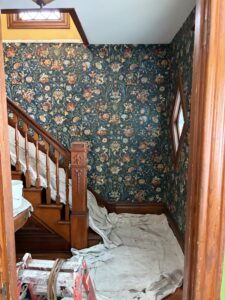
Winter is a great time to paint the inside of your house, and in Milwaukee it may even be the best time. The conditions that make December through March hard on exterior paint work are the same conditions that leave your interior at a steady 68 degrees with a crew that can get to your project in weeks instead of months.
There is a catch. The problem with painting indoors in January isn’t the cold. It’s what your furnace does to the air once that cold air gets inside and warms up. There are easy solutions.
We’ve been painting homes in Brookfield, Mequon, Wauwatosa and the surrounding Milwaukee suburbs since 2009, and the winter jobs that go sideways almost always come down to dry air and cold wall surfaces rather than the thermometer on the porch.
Is Winter a Good Time to Paint the Inside of a Wisconsin House?
Yes, for any space inside your home’s heated envelope. A room that is comfortably 65+ degrees and remains there overnight gives paint perfect conditions for drying.
In fact, what’s important in winter isn’t really whether you can paint, it’s what you or your professional painters might have to manage while you do it. Three things behave differently once your furnace is running daily: 1) the air is dry enough to shorten how long paint is workable/pliable; 2) the inside faces of your exterior walls are colder than the room; and 3) nobody’s opening a window for ventilation. Each of those has an easy fix.
How Cold Is Too Cold to Paint Indoors?
Most interior latex needs the air, the surface, and the paint itself at 50 degrees or warmer during application and while it dries. Sherwin-Williams, which is what we’ve used on homes here for about two decades, publishes its dry and recoat times at 77 degrees and 50 percent relative humidity, and their Emerald interior product data sheet gives one hour to touch and four hours to recoat under those conditions.
Below the 50-degree floor your paint stops coalescing as well, and the resin particles may never fuse into a continuous film, which can mean a coat that looks fine in February but then burnishes, peels or washes off in April.
Interestingly, your thermostat isn’t the only number that matters. Surface temperature is!
In a 1920s bungalow in Wauwatosa with no wall insulation, the inside face of a north-facing exterior wall can be eight to twelve degrees below the room air. Set the thermostat to 68 and that plaster might be at 56. Still above the lower threshold, so the job is fine. But on a stretch of single-digit days, in a room with an uninsulated wall and a drafty window, that painting surface can be under 50 while the thermostat looks normal!
A $25 infrared thermometer solves this quickly and easily. Point it at the wall you’re about to paint, not at the middle of the room, and check the corner by the window along with the open field of wall. If you’re hiring out the work to professional painters, it’s a reasonable thing to ask whether your contractor does this.
Drafts can change things for the same reason. A window that leaks air will keep one end of a room colder than the rest.
One more thing on cold. Latex that freezes even once is ruined, so our paint never spends a January night on a truck. It comes inside at the end of the day, every day. If you’re buying your own material for a DIY project, carry it in from the car rather than leaving it in the garage overnight.
What Does Dry Winter Air Do to a Coat of Paint?
Dry air makes paint set up faster, which helps you on a small job but works against you on a larger wall. Paint that skins over before you can keep a wet edge can leave lap marks, visible roller stops, and a cut line around the ceiling.
Cold outdoor air holds almost no moisture, so when your furnace heats it, the relative humidity falls. The Center for Energy and Environment, a nonprofit in Minneapolis working on cold-climate housing, publishes a sliding scale for how much humidity a heated house can hold without condensing on the windows: under 35 percent when it’s 10 to 20 degrees out, under 30 percent at 0 to 10 degrees, under 25 percent below zero.
Compare that to the 50 percent relative humidity the paint manufacturers use for their stated dry times. A Milwaukee house in a cold January week is already at roughly half the moisture painting providers want. A good thing, except for when it sets up TOO fast. On a bedroom, you’ll never notice. On a two-story stairwell or a twenty-foot great room wall, this is the difference between an even finish and one you see from the couch.
To solve this, we just cut and roll in smaller sections and keep more painters working on a bigger wall so the edge stays wet. A humidifier running at 30 to 35 percent during the job can help if you already own one, though we wouldn’t buy one for this.
Does Winter Change What Gets Patched and Caulked?
It changes what we caulk, not what we patch. Nail pops, drywall cracks, dents from a chair back, gouges from a move: you can fill those any month of the year.
Caulk is different in an old house. Wood trim in a Shorewood four-square or a Brookfield colonial loses moisture all winter and then sucks it back up in summer. The joints then move with it. A gap between a baseboard and a plaster wall is at its widest in January. If you fill that gap right to the edge in February, by the Fourth of July the wood has swelled back up and the bead can be compressed into a ridge. It just calls for a lighter touch.
How Do You Ventilate When You Can’t Open a Window?
You pick a product that doesn’t need a window!
Cracking the window sash when it’s 12 degrees outside drops the room below the application floor and pulls the humidity down further, so it really solves nothing.
One thing our crews can do in a winter room is tape off supply registers for forced air heat. Forced air blowing across a wet wall dries one patch faster than the rest and lifts dust off the floor into the finish.
After that it’s gentle air movement rather than a fan pointed at the wall. A box fan aimed at fresh paint in a dry room will flash the surface and make the lap marks worse. We want the air in the room turning over slowly, not a breeze across the coating.
Since we spray most of our interior work, containment does more for air quality in winter than ventilation does. Plastic at the doorways, floors covered well, and the overspray will stay in the room rather than drifting down a hallway.
Will the Paint Smell Be Worse in a Closed-Up House?
It’ll last longer than it would in June. In a house that’s sealed until spring, odor has nowhere to go and will hang around for a day or two rather than a few hours.
The answer to avoiding the smell of paint is to specify a low-VOC or zero-VOC product. Sherwin-Williams has several interior lines formulated for this, including zero-VOC options in the ProMar range and low-odor formulations for occupied spaces. These are our default on winter interiors and on any job where somebody is sleeping in the house that night, which in January is every job.

Which Rooms Are Worth Painting Before Winter?
The ones winter is about to be hard on, and the ones you’re about to spend four months in.
Entryways and mudrooms take the worst of it. Salt, slush and boot grit go after the lower three feet of a wall from December to March. This is the one place we’ll push a homeowner toward a scrubbable finish in a satin or semi-gloss rather than a flat paint color.
Kitchens are ideal to get done before the holiday cooking rather than after. Finished basements turn into the room everybody lives in once it’s dark at 4:30. Bedrooms and family rooms are where the color decision has the most weight, since you’ll see those walls under lamp light and grey afternoon light for months rather than June/July sunshine.
Which Interior Projects Should Wait Until Spring?
Anything outside the heated envelope. The clearest example is an uninsulated attic with drafty windows, where you can’t hold 50 degrees at the surface no matter what the thermostat downstairs says.
An unheated garage is the same answer.
A three-season porch is the same answer.
Two projects work better in winter than people expect. Kitchen cabinets are a cold-weather job in our shop, since the doors come off and finish in a controlled space rather than in your kitchen, and the cabinet painting calendar is more open in January than it’ll be in May. Wallpaper removal is winter work too. It’s slow, messy, and entirely indoors, and getting it done now means the walls are ready when you want the room done.
Do Painters Charge Less in Winter?
Not generally, as our pricing is the same in January as it is in June. Plenty of painting companies do advertise winter specials, though. Our breakdown of what it costs to paint a home walks through how we get to a number.
What you get in winter is a more open calendar. Exterior work stops, so we have more room for interior painting.
What Should You Have Ready Before the Crew Arrives in January?
Not too much.
- Clear a path from the driveway to the door and keep it salted. Our people are carrying sprayers, ladders and five-gallon buckets across whatever’s on your walk at 7:30 in the morning.
- Decide where the furniture goes before we get there. This is the one winter problem with no great fix. In July you move a bedroom’s worth of furniture into the garage. In January that garage is full and the rest of the house is already closed up. Picking that spot in advance beats figuring it out while four people stand in your hallway.
- Plan for your pets. The house is sealed, the crew is moving between rooms with plastic up, and a cat that bolts has fewer places to go and more open doors than usual.
- Leave the heat where you normally keep it. People sometimes turn the thermostat up to 75 thinking it helps the paint. It dries the air out further and costs some working time. Normal is what we want.
- If your home was built before 1978, ask about lead-safe practices before any sanding starts. We’re lead-safe certified, and in a sealed-up winter house, dust containment is the part that matters most.
Ready to Paint Something This Winter?
If there are rooms you’ve been putting off, this is the stretch where you get to pick your week instead of taking whatever’s left.
Give us a call to schedule a free consultation.
We’ll come out, walk your space with you, look at the walls and the windows in each one, and give you a written estimate for your interior painting project. When you’re ready, we’ll get you on our calendar!