We get asked to paint Cream City brick a few times every summer. Usually it’s a homeowner in Bay View or on the East Side who has looked at the same sooty gray-brown wall for fifteen years and finally had enough of it. We understand the impulse, and we also talk many of those people out of painting their brick. The reason has less to do with preservation sentiment than with what we’ve watched happen to houses that were painted forty years ago.
The history explains the problem with painting Cream City brick, so let’s start there.
What is Cream City brick?
Cream City brick is the pale yellow brick that gave Milwaukee its nickname. It was made from clay dug right here, mostly out of the Menomonee River Valley and along the western shore of Lake Michigan, starting in the 1830s. The Encyclopedia of Milwaukee describes the result as a soft golden-yellow brick fired from local red lacustrine clay. The word “soft” is going to matter later.
The color was an accident of geology. Most clay is fired to a deep red because of the iron in it. The glacial lake clay under Milwaukee carries unusually high amounts of calcium and magnesium, and those minerals change what the iron does in the kiln. Geologist Raymond Wiggers explained it to WUWM as chemistry and heat together: burn that much calcium and magnesium along with the iron, push the temperature a little higher than most brickmakers would, and you get a pale yellow instead of red. Milwaukee’s brickmakers generally did fire it hot.
The first ones weren’t trying to make a pale brick at all. They were after red, like the brick coming out of the East, and what came out of the kiln was something else entirely! Urban Milwaukee’s history of the industry puts it bluntly: the cream color came as a surprise and a disappointment to the brickmakers working here in the mid-1830s. The bricks also didn’t sell well at first, because they cost more than the alternatives.
Solomon Juneau wanted brick made here rather than shipped in, and in 1835 he brought in two young brickmakers from Canton, New York. They opened a clay pit near the lakeshore and built what’s believed to be the first brick kiln in Milwaukee, a 25,000-brick oven, according to the Shepherd Express. What came out of it was gold, and it turned out to be strong and weather-resistant.
How Milwaukee Became the Cream City
By the 1850s this brick was in demand across the Great Lakes and the Midwest, and in 1859 a ship called the M.S. Scott even carried a load of it all the way to Hamburg, according to the Shepherd Express. It was the second ship ever to leave Milwaukee for a foreign port. European architects began using the brick as ornament. A brick nobody had wanted twenty years earlier was crossing the Atlantic because it didn’t look like anything else.
The industry that grew around it was substantial too. The Encyclopedia of Milwaukee notes that Wright’s City Directory listed twelve brickyards here in 1892, with the Burnham yard the largest and longest-running of them.
All of it moved by horse. Brick came out of the kilns, went to the storage sheds, then got hauled by cart to a rail car or a ship. Urban Milwaukee, writing about a photograph of a Milwaukee brick factory taken around 1885, points out that this took massive amounts of horsepower and very sturdy carts, with clay at most yards dug by pick and shovel and hauled in by the cartload. If you’ve ever carried a pallet of brick across a jobsite you have some idea what that work was.
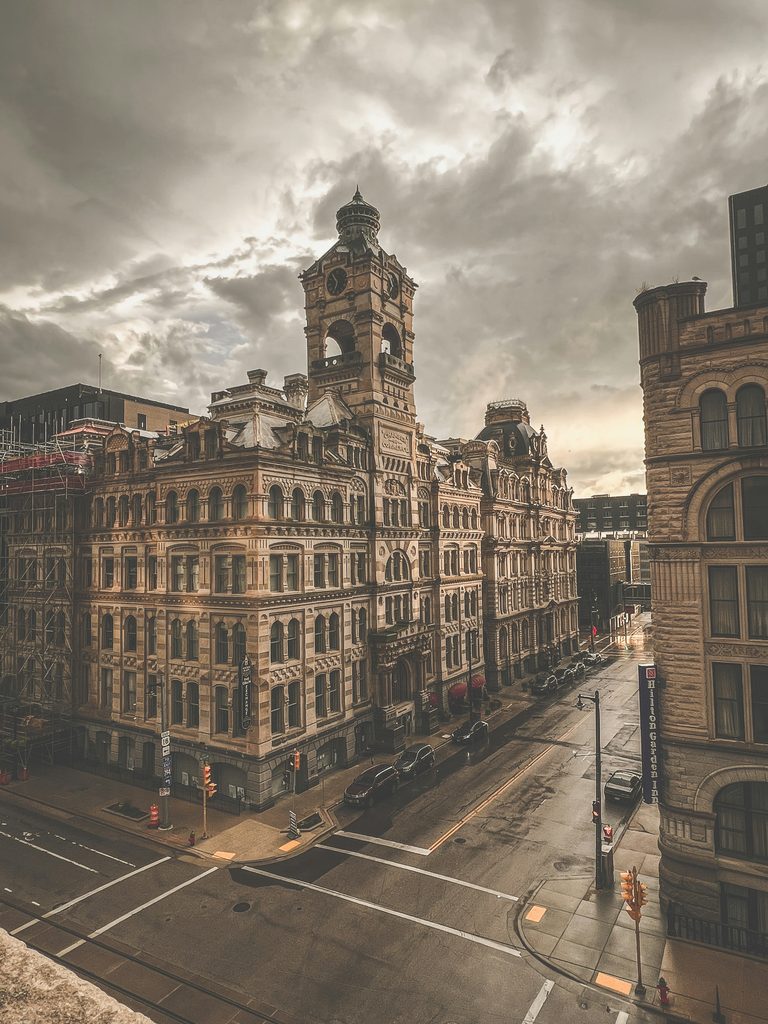
St. Mary’s on Broadway went up in 1846. The main building at the National Soldiers Home in 1867. St. Stanislaus in 1873, Turner Hall in 1882. All are still standing, along with thousands of houses and duplexes across the older neighborhoods made of that unique Cream City brick.
Why Did They Stop Making Cream City brick?
Production of Cream City brick wound down around the turn of the century and ended in the 1920s. Andrew Stern, the City of Milwaukee’s senior planner of historic preservation, gave WUWM the short version, which is that architectural taste had shifted toward marble and stone by about 1900; red brick had become easy to ship in by rail; and a number of the clay deposits were simply exhausted around the same time. Demand fell off. Milwaukee Magazine’s history of the brick tells it the same way, and the Encyclopedia of Milwaukee adds that the standardized red brick coming from national manufacturers was both harder and cheaper.
There’s a fourth thing, and it’s the one that matters for our purposes. Cream City brick is porous. Milwaukee in its industrial years put a great deal of coal smoke into the air, and the brick absorbed it. The Shepherd Express describes the pale brick losing its luster by the 1900s as it took in the smoke and dirt of the city’s industrial heyday and blackened over time. Buildings that went up beautifully gold were turning dingy and dark, which is when the city stopped treating the brick as a point of pride and started treating it as something to cover up.
That’s usually the wall our customers are looking at when they call us!
Should You Paint Cream City brick?
In many cases, no. The same porosity that soaked up a century of coal smoke is what makes this brick a tough candidate for ordinary paint.
Brick breathes, and moisture moves into it and back out of it constantly, through the face and through the lime mortar joints. This is how the wall has managed water since it was built. Put a film-forming coating over it, an oil-based masonry paint or most modern acrylics, and you’ve sealed the outside face while leaving every other path for water into the wall wide open. Rain can even get behind it through a hairline crack in the mortar. Vapor comes through from inside the house.
Then it’s December and the trapped water freezes.
Ice takes up more room than water, and the pressure has nowhere to go except outward through the face of the brick. It can blow that face off in sheets. This is called spalling. We’ve pulled up to houses where a south-facing wall looks fine and the north wall is pitted like it caught birdshot, and the difference is from sun exposure and how long the wall remains wet after a rain. Hard modern brick takes a fair amount of this. Cream City brick was coming out of the kiln soft and has not gotten harder in 140 years.
This isn’t just our opinion. The Brick Industry Association advises against putting traditional paint on brick masonry at all, for exactly this reason: the risk of trapping moisture inside the brick, where the outer layer then flakes and cracks as that moisture freezes and expands. Any masonry restoration contractor in this city will tell you the same thing.
Painting it is close to a permanent decision
Milwaukee learned this the hard way once already. When restoration work on Cream City buildings picked up in the 1970s, sandblasting was the first thing people tried, and OnMilwaukee’s history of the brick describes the result plainly: it didn’t get the buildings clean and it chewed up the brick. Chemical washes became the accepted approach instead. The federal government’s own masonry guidance, following the Secretary of the Interior’s Standards for Rehabilitation, says flatly that sandblasting is not to be used on historic brick, and that high-pressure water blasting can erode soft brick and drive moisture into the wall.
So when someone asks us to paint Cream City brick, what we’re really being asked is whether we’ll do something the next owner may not be able to undo without wrecking the wall. We usually say no, with one exception…
What We Propose Instead of Standard Paint for Cream City Brick…
Clean it first.
A surprising number of people have never actually seen their own brick. What’s on the wall is atmospheric grime, not a change in the brick itself, and appropriate masonry cleaning takes a lot of it off.
This has to be done carefully.
High-pressure washing on soft brick and lime mortar does damage, so it’s low pressure and the right chemistry, not a 4000 PSI wand. That’s a different job from the power washing we do on siding before a repaint. When it works you get the original color back, and you’ve changed nothing about how the wall handles water.
Limewash, if you want a real color change.
Limewash isn’t paint in the way most people mean the word. It’s slaked lime and water, and it bonds into the masonry through carbonation rather than sitting on top as a film, so the wall remains vapor permeable. The Brick Industry Association points to limewash and mineral paints as the alternatives worth considering precisely because they bond to the brick without forming a film, which keeps the breathability intact and holds up longer than conventional paint. It weathers instead of peeling, and it can be reapplied without the scraping-and-priming cycle that painted masonry demands forever after.
It also doesn’t look uniform, which some people love and some people don’t. There’s more in our post on what lime washing brick involves.
Fix the water, whatever you decide.
Gutters, downspout extensions, flashing, grading away from the foundation, failed mortar joints. If a wall is getting wet from a source that nobody has addressed, no coating will help and most even make it worse. Repointing is important too. Soft lime-based mortar rather than a hard portland mix, because hard mortar against soft brick forces moisture to move through the brick instead of the joint, and the brick can, again, spall.
If your brick isn’t Cream City, the math is different as harder red brick, and certainly brick on postwar houses, tolerates coating much better.
We paint exterior brick regularly as part of our residential exterior painting work. The caution above is specific to soft historic masonry.
How To Tell If Your House is Cream City Brick
- Look at the color under the dirt, at a sheltered spot like beneath a porch roof or behind a downspout where the wall remained clean. Cream City is pale yellow to buff, sometimes nearly white.
- Look at the mortar. An original wall will have soft, light-colored lime mortar rather than the gray portland you see on newer work.
- Feel the face. Soft brick has a slightly chalky, absorbent quality and darkens visibly when you wet it.
Houses built in Milwaukee before roughly 1900 are common candidates. Much of the housing stock in Brewers Hill, Walker’s Point, the near East Side and Bay View qualifies, along with the older sections of Wauwatosa and Shorewood. Some of it is hiding under aluminum or vinyl siding installed in the sixties. Every so often a siding tear-off turns into a very good day for the homeowner.
One more thing worth knowing if your house is from that era. It almost certainly has lead paint on the trim and the windows, whatever is happening with the brick. That’s a separate conversation and a real one, and we’ve covered it in our posts on lead-safe painting practices and how lead-safe renovation differs from abatement.
If you’re trying to work out what your particular wall needs, we’ll come look at it. Get in touch and we’ll tell you honestly what we’d do, including the times the answer is to leave it alone.
Common Questions About Cream City brick
Can you paint Cream City brick?
You can, though with some nuance. The brick is soft and porous, and film-forming paint traps moisture inside the wall. During Wisconsin freezes that trapped water expands and blows the face off the brick. Removal later risks damaging the brick further, so it’s close to a permanent decision.
What gives Cream City brick its color?
High calcium and magnesium in Milwaukee’s clay. Fired hot alongside the clay’s iron, those minerals produce a pale yellow brick instead of the usual red.
Why is my Cream City brick dark or black?
Decades of coal smoke and industrial pollution absorbed into the porous surface. It’s surface grime rather than a change in the brick, and careful low-pressure masonry cleaning usually brings back the original color.
What’s the alternative if I want to change the color?
Limewash or a mineral silicate coating. Both bond into the masonry but are vapor permeable, so the wall can still dry out.
When did they stop making Cream City brick?
Manufacturing ended in the 1920s, after the best clay deposits were exhausted and cheap red brick began arriving by rail.